· History ·
[ background · style · last series · reception · wodehouse · survival status ]
 |
|
|---|
Background
In the early 1960s, Ian Carmichael and his former agent Richard Stone briefly discussed bringing Bertie Wooster to television audiences, but “the idea was no sooner discussed than discarded”1 owing to Carmichael wanting to steer his career in another direction. Unbeknownst to them both, a few years back he had been considered by BBC Head of Light Entertainment Eric Maschwitz in the event of a Jeeves series being produced for television2. In late 1964, the actor had appeared in Michael Mills' Ninety Years On, a BBC celebration programme for Churchill's 90th birthday, and Mills discussed his next project with him: a half-hour comedy series adapted from the Wodehouse stories, for which he wanted Carmichael to play Bertie. Although Carmichael was initially still opposed to the idea, he was quickly spurred by Mills' enthusiasm for the project. But he had already been contracted for a new play shortly opening in New York which, if successful, would have him stay in America for a year, so he again dismissed the notion. Instead, the play had a three-week run, and by February 1965 Carmichael had returned to England.
Filming would start in April. The series was to be produced by Mills, alongside Frank Muir and Peter Cotes, and would consist of six half-hour shows, with half of them scripted by Mills and the other by Richard Waring. Both writers discussed with Carmichael which stories to adapt, and he was the first to be sent scripts to review and amend. With only one story and two novels in the Jeeves canon yet to be published, there was a wide array of material to choose from. There had already been a few attempts at transposing Wodehouse's memorable duo to the screen and airwaves, but none were particularly successful. The author had been a popular dramatist but himself confessed to the difficulty of transposing Bertie's narration — on which most of the humour of the Jeeves stories hinges — to radio without seeming to read directly from the original material. At Carmichael's suggestion3 4, it was agreed that most of Bertie's inner monologues should be transformed into dialogue between him and Jeeves.
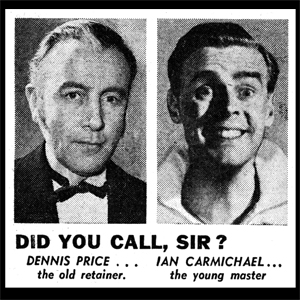
If Carmichael had been picked as Bertie from the start, the choice of who was to play Jeeves was more difficult. Like all good double-acts, the two have to play well against one another and much of the success of the adaptation would be contingent on the chemistry of the leads. Over a few days, Carmichael read from “a long duologue from the proposed first episode”5 with a variety of actors, and formed his view of how to play his version of Bertie. Dennis Price, a self-described Wodehouse fan, had initially been approached by Mills regarding the role whilst filming Ten Little Indians in Dublin, and was ultimately selected for the role. The recording schedule was to be five days every week for six weeks6, later once a fortnight to fit around the stars' stage commitments7, and the first episode of The World of Wooster went out on May 30th, 1965, on a BBC One evening slot.

1. Will the real Ian Carmichael: an autobiography, Ian Carmichael, 1980, p.366.
2. This Charming Man: The Life of Ian Carmichael, Robert Fairclough, 2011, p.196.
3. Sunday Telegraph, May 27th, 1979.
4. Will the real Ian Carmichael: an autobiography, Ian Carmichael, 1980, p.376.
5. Ibid, p.377.
6. Ibid.
7. Manchester Evening News, January 8th, 1966.
Style
All episodes of The World of Wooster were filmed in black and white, as the BBC would not begin switching to colour programmes until mid-1967. Although sometimes film inserts and exterior shots were used, judging by the remaining footage and pictures, most scenes feature fairly simple studio sets. The production allowed for few edits, with indoor scenes “recorded ‘as live’, in other words like a stage play performed before the cameras and a live audience”1 2.

Although by far the most faithful adaptation up to then, the interpretation of Jeeves' and Bertie's characters does differ from the page. Carmichael plays Bertie in much the same way he had portrayed other comedic roles earlier in his career, and his most obvious traits are his stammer (or ‘speech hesitation’ as he called it3) and his perpetual monocle. The former drew contemporary comments, but not the latter, as public perception of the character had associated him with the non-canonical accessory since his first appearance in the Saturday Evening Post fifty years earlier, thanks to a slew of illustrators using it as a graphic shorthand for depicting an upper-class gentleman. Most notably, Carmichael was now almost forty-five, and much too old for the character, a young bachelor in his mid-twenties when we first meet him. This is not to say that an older Bertie isn't conceivable, as the play-turned-novel Ring for Jeeves is set in the early 1950s and had established that even then the status quo remains the same: he is still unmarried, struggles to adapt to a post-war world, and retains Jeeves in his employ. It simply is a stretch at times when a large number of plots revolve around his various romantic entanglements and engagements to women supposedly his age, but Carmichael has a joyful boyishness that makes it possible to suspend one's disbelief.
Dennis Price, on the other hand, offers a suitably mature Jeeves and a very professional keeper of not-too-young masters. Jeeves' age is never mentioned, but he is assumed to be no more than a decade older than Bertie. Price, approaching his fifties, brings his trademark suaveness to the dignified figure. Waring's and Mills' characterisation of Jeeves seems to be more laid-back than in the original stories, often Price's valet is content to glide in and out of scenes, offering anything from pep talk to words of comfort, while quietly solving his employer's problems rather than engineering devious schemes to turn situations to his own advantage. Jeeves is a character with a complex psyche who is often working to manipulate events to produce a satisfying result for his master's own good, or for his own ends. He is not above going against people's wishes and committing crimes to achieve his purposes. Price appears to play a warmer Jeeves, still intelligent and full of feudal spirit, but straightforward in his stratagems. It also seems as though his and Bertie's numerous feuds about fanciful articles of clothing, a near-omnipresent element of the stories, have been pared down in the programmes.
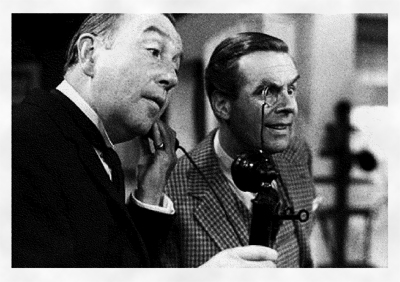
The stories were rearranged and sometimes blended to make the series more cohesive and easier to follow for viewers unfamiliar with the source material. For example, in “Jeeves and the Delayed Exit of Claude and Eustace”, the adaptation of the eponymous Wodehouse story is combined with “Sir Roderick Comes to Lunch”, but Sir Roderick is replaced by the invented character of Sir Humphrey Wardour in order to link an engagement between Bertie and Sir Humphrey's daughter with the Claude-and-Eustace storyline in which they become suddenly infatuated with the very same Miss Wardour. Other minor changes were sporadically implemented throughout the series presumably in a similar vein to improve the narratives in a way that better fit the ‘half-hour farce’ format.
1. This Charming Man: The Life of Ian Carmichael, Robert Fairclough, 2011, p.201.
2. 2002 BFI interview
3. Will the real Ian Carmichael: an autobiography, Ian Carmichael, 1980, p.377.
Last series
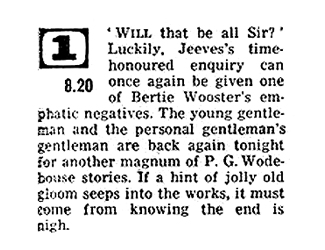
By 1967, Carmichael was eager to move on to other projects. Although with Mills and Waring they felt like they were “scraping the bottom of the barrel” of adaptable stories1, the chosen narratives for what proved to be the final series of programmes are as good as the rest. The first episode to go out even featured “Jeeves and the Greasy Bird”, freshly published in the UK earlier that year. As with the previous two series, the shows were an instant success among viewers.
It was decided that, should the BBC ask for a fourth series, the team would turn to dramatising a novel, but Carmichael remained dubious of the efficacy of a change of format, feeling that self-contained episodes were better suited to weekly television presentations. Richard Waring wrote a draft of The Code of the Woosters which the team considered, but it was ultimately decided to end the series there. Waring instead wrote for the second series of The World of Wodehouse, focussing on another of Wodehouse's scheming characters, Ukridge. The series — also considered lost — had been commissioned as a result of the success of The World of Wooster and had a successful first run earlier in 1967, with episodes based on the Blandings Castle stories and produced by Michael Mills. Mills went on to serve as the BBC's Head of Comedy until 1972.
1. Will the real Ian Carmichael: an autobiography, Ian Carmichael, 1980, p.387.
Reception
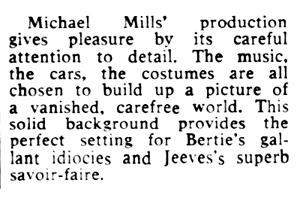
The programmes received critical acclaim in Britain, and were subsequently repeated on the BBC, as well as being exported as late as the early 1970s to various countries such as Australia, Canada, and Singapore. They also led to a few tie-in releases: a re-print of all Jeeves books published up to this point, with colour covers featuring Carmichael and Price, as well as a 45pm record and a Corgi miniature. In 1967, the BBC estimated its television audience for the Tuesday evening slot of the second series to have reached over ten million viewers1.
Mills and Waring won awards from the Guild of Television Producers and Directors in 19652 for ‘Best Comedy Series’ and ‘Best Scriptwriter’, and ‘Best British Dramatisation’ from the Writers' Guild of Great Britain in 19673. The episode “Jeeves and the Delayed Exit of Claude and Eustace” was selected as the BBC's entry for the 1966 Rose d'Or Awards, and “Jeeves and the Greasy Bird” was entered in the 1968 Monte Carlo International Television Festival.
1. BBC Handbook 1967, p.37.
2. BAFTA.org
3. The BBC Annual Report and Accounts for the Year 1966-1967, p.22.
Wodehouse on Wooster and his world
After the fiasco of the two 20th Century Fox Pictures, Wodehouse had been wary of adapting the Jeeves stories for other mediums. In 1950, he wrote to his step-granddaughter about going to an “awful” audience try-out for a proposed NBC radio series. A few weeks before broadcast of the first episode of The World of Wooster, he told Charles A. Goodrum that he was “rather dubious about those TV Jeeves things the BBC are doing...I doubt if it will be all right on the screen”1.
Wodehouse only ever saw the very first two episodes, brought to his Long Island home by Frank Muir for a private viewing in the summer of 1965. After watching them — or most of them, as Muir recounts Wodehouse having fallen asleep during a technical glitch with the projector — he wrote to the team of how delighted he was with the performances, “Bertie and Jeeves are just as I have always imagined them”2. He was slightly less effusive in a letter to his friend Lord Citrine, judging “both sketches...fine”3.
In a 1967 interview with Ruth Inglis, he was still full of praise for the series, although he recalled having seen three episodes and couldn't remember Price's name. Two years later, he was quoted as having found the programmes “rotten”, but apologetically wrote to Ian Carmichael, whom he was in the habit of corresponding with, that “I can assure you that I have never said anything remotely resembling what I am credited with”4.
1. Letter to Charles A. Goodrum, 3rd May, 1965.
2. Letter to the team, July 19th, 1965.
3. Letter to Lord Citrine, July 24th, 1965.
4. Will the real Ian Carmichael: An Autobiography, Ian Carmichael, 1980, p.389.
Survival status
Although extremelly popular when first broadcast, most of the episodes are now lost due to the BBC's wiping practices and lack of archival policies at the time, as were many other programmes, such as the follow up series The World of Wodehouse.
As of 2026, the two remaining complete episodes out of the twenty broadcasts are “Jeeves and the Delayed Exit of Claude and Eustace” and “Jeeves, the Aunt, and the Sluggard”, with fragments from “Jeeves and the Indian Summer of an Uncle” also existing. Additional clips from unspecified episodes, possibly only the last series, were recovered in 2007 from Australia1 2. The series ranks at #51 on Ray Lanstone's Top 100 Lost TV Shows list.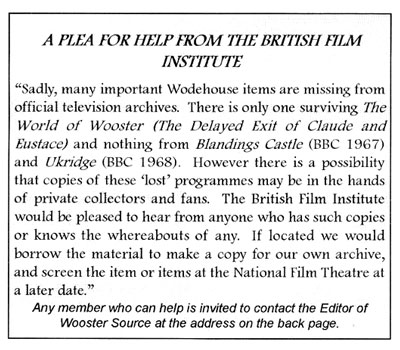
“A Plea for Help from the BFI”, Wooster Sauce, No. 1, March 1997
1. missing-episodes.com
2. “25 mins compilation back from Australia, excerpts of comedy shows to be used for trailers; they include short sequences from ... some ‘World of Wooster’” missing-episodes.com